Science has revealed a fascinating truth: the act of observing can influence what we see. In quantum physics, when a particle is observed, its behavior changes. Interestingly, spiritual traditions have spoken about this power of observation for thousands of years. They remind us that the way we observe our inner world also transforms it.
When we observe our thoughts and emotions, something subtle shifts. Imagine feeling anger or fear. If you react immediately, the emotion takes control. But if you pause and simply notice it without judgment, it begins to lose its force. You are no longer trapped inside the emotion; you are observing it. This awareness changes your relationship with your thoughts, and they no longer define you.
Observation is not suppression. It is about seeing clearly. Thoughts and emotions are like waves on a vast ocean. They rise and fall, but the ocean itself, the awareness within, remains steady and deep. This realization brings a quiet sense of freedom. We move from reacting to responding, from confusion to clarity. In that pause of awareness, the mind begins to heal itself.
Many traditions describe this same truth in different ways.
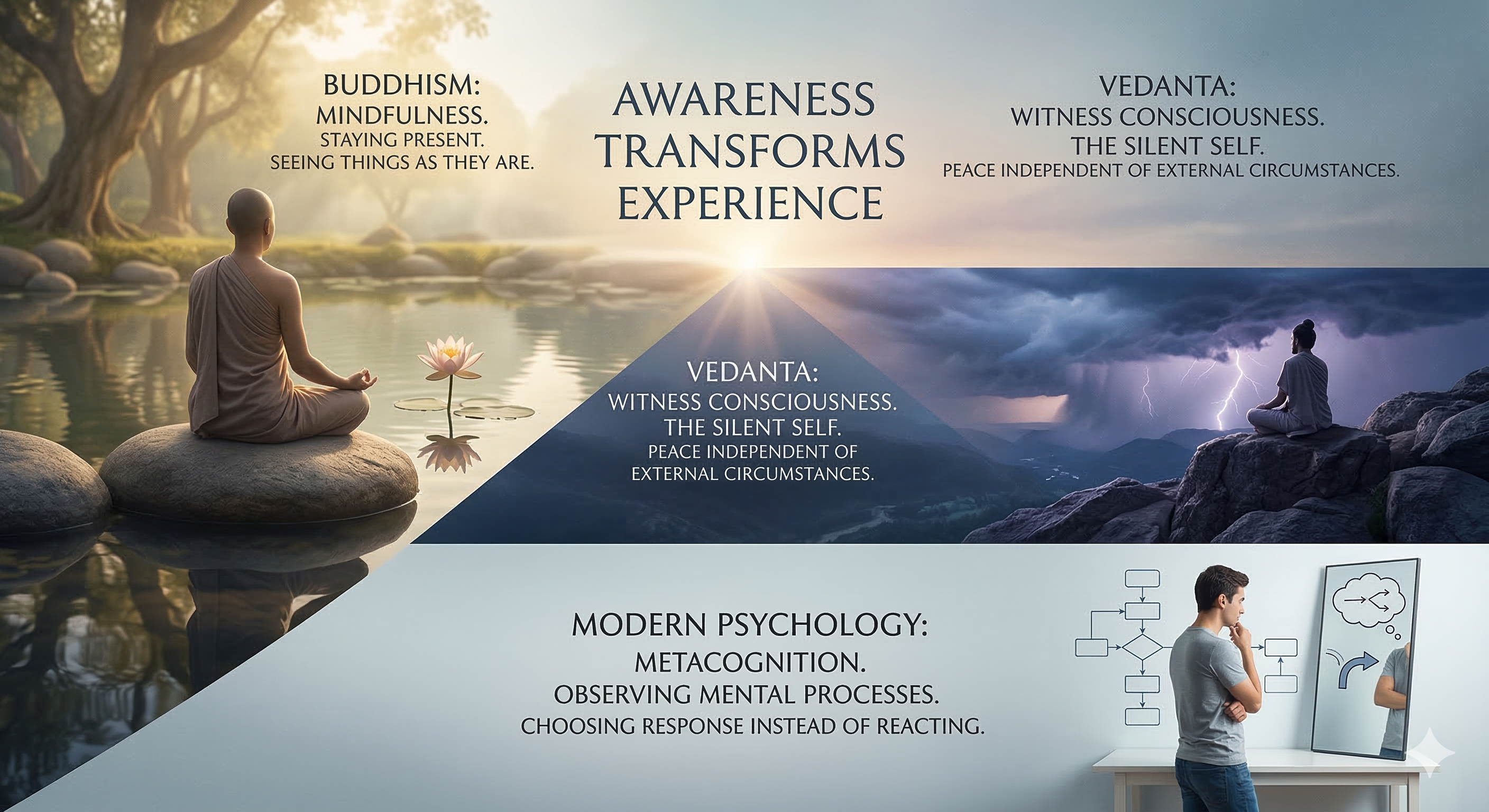
In Buddhism, it is called mindfulness, the practice of staying present with what arises from moment to moment. Through mindful observation, we see things as they are and not as we imagine them to be.
In Vedanta, it is known as witness consciousness. It refers to the silent self that observes experiences without becoming entangled in them. When we recognize this inner witness, we discover peace that does not depend on external circumstances.
In modern psychology, the same idea appears as metacognition, the ability to observe one’s own mental processes. When we become aware of our thinking, we create space to choose our response instead of reacting automatically.
Though the language differs, the essence remains the same: awareness transforms experience.
Cultivating this awareness is simple. Start with small moments. Notice your breath as you inhale and exhale. Watch your thoughts appear and pass like clouds drifting in the sky. When worry or frustration arises, pause and quietly say, “A worried thought is here.” This act of noticing changes the quality of the emotion. Its hold begins to fade.
The beauty of this practice is that it does not require belief or great effort. It only needs a willingness to observe without judgment. Over time, emotions soften, and thoughts lose their intensity. Life feels lighter and more peaceful.
Observation will not remove challenges, but it changes how we meet them. Instead of being carried away by fear or anger, we stand as steady witnesses. Even in difficult moments, there is a quiet knowing that says, “This too shall pass.”
The observer effect reminds us that awareness itself is a creative power. In the physical world, it influences particles. Within us, it transforms consciousness.
So today, take a quiet pause. Watch your breath, your sensations, and your thoughts. Let them come and go naturally. In that still awareness, you will touch the peace of your true nature, the silent witness within.
Leave a Reply